

Generative AI and local leads: how to connect AI citations to real leads
A missed call at 10 p.m., a branded search in Google, a form filled out the next day: AI may have helped the decision without showing up clearly in your reports. The topic deserves better than a reflex; it calls for a diagnosis.

Lila HNAT BENGUEDACH
Published on 10 min read
You open your analytics tools, you filter referrals coming from tools like ChatGPT, Gemini, or Perplexity, and the verdict seems quick: almost nothing. The problem is that this reading may be too short.
Opinions converge on one point: in local, AI assistants can influence the discovery of a business without immediately generating a measurable click. On the other hand, they diverge on the robustness of the figures, the real scope of the signals, and the recommendations to generalize.
At BL Digital, our position is simple: reflex is not a strategy; we diagnose before acting. So here is what we know, what we can reasonably infer from it, and what still needs to be verified before turning a trend into an action plan. 💡
Why leads from AI remain difficult to attribute
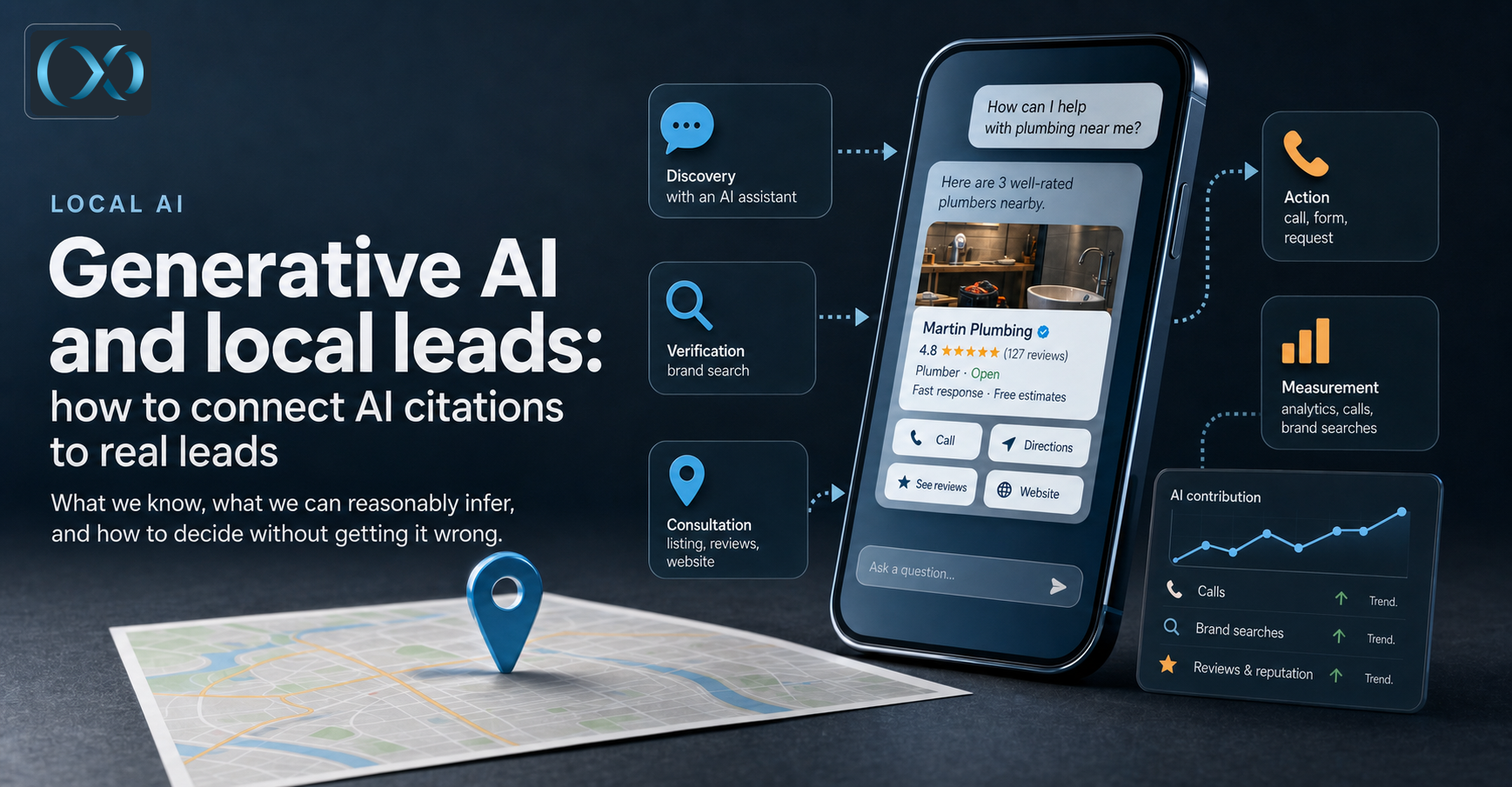
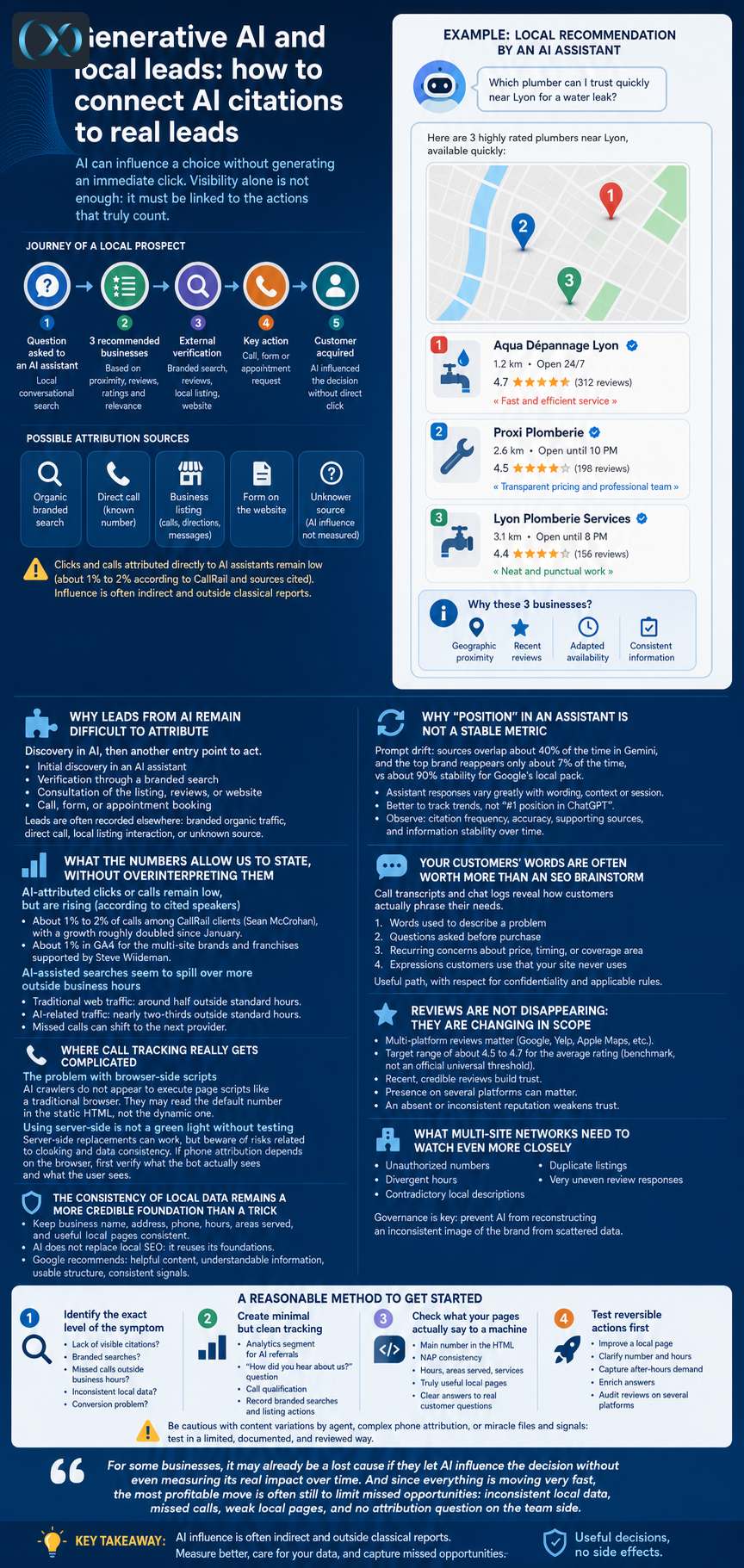
The journey described by the sources is consistent: a user asks a local question to an assistant, sees a few recommended businesses, then goes through another entry point to act.
In concrete terms, it can look like this:
- initial discovery in an AI assistant;
- verification through a branded search;
- consultation of the business listing, reviews, or website;
- call, form, appointment booking.
In this scenario, the assistant contributed to the decision, but the lead will often be recorded elsewhere: branded organic traffic, direct call, interaction with the local listing, or unknown source if no one asks the customer the question.
This is precisely the angle developed by the article from Search Engine Journal on the link between AI visibility and local leads, based on a conversation between CallRail’s Sean McCrohan and Steve Wiideman. The difficulty is therefore not only to “bring in AI traffic,” but to reconstruct a partial contribution in a multi-step journey.
What the numbers allow us to state, without overinterpreting them
Several figures stand out, but they are not all equal. They must be read with caution, because they come from speakers, vendors, or secondary articles.
Clicks or calls attributed to AI remain low, but are rising according to the speakers cited
Search Engine Journal reports that, according to Sean McCrohan, clicks or calls linked to AI citations represent about 1% to 2% of calls among CallRail clients, with an increase approximately doubled since January. The same article indicates that Steve Wiideman observes a similar order of magnitude of 1% in GA4 for the multi-site brands and franchises he supports.
The important point is not to retain a universal percentage. The important point is this: measurable signals exist, but remain modest in the environments cited.
In other words, if you are already looking for an explosion of traffic directly attributable to assistants, you are likely to be disappointed. If, on the other hand, you are looking for an emerging discovery signal, these data suggest that it deserves to be tracked.
AI-assisted searches seem to spill over more outside business hours
Still according to the speakers cited by Search Engine Journal, the “ordinary” web traffic observed by CallRail has historically been distributed around half outside standard hours, while the AI-related share rises to nearly two-thirds.
This is an interesting operational point, especially for high-intent local activities, such as urgent services. If an assistant highlights three providers, a missed call can shift to the next one.
Here again, caution: this is not a general law of the local web. It is vendor feedback reported by a media outlet. But for a reader who manages a switchboard, appointment bookings, or after-hours support, it is a very concrete signal to watch. 🔎
Where call tracking really gets complicated
One of the most useful parts of the corpus concerns the phone. Many local businesses live on calls, not just forms. And this is precisely where attribution becomes fragile.
The problem with browser-side scripts
Search Engine Journal reports a technical point raised by Sean McCrohan: the crawlers used by AI agents do not appear to execute page scripts like a traditional browser. If your tracking system relies on JavaScript-based client-side number replacement, the agent may never see that dynamic number.
In plain terms, the assistant may read the default number in the static HTML, not the one injected later into the page.
This is an important nuance because it avoids a common false shortcut: “my tracking is in place, so my AI attribution is too.” Not necessarily.
Using server-side is not a green light without testing
The same article reports that server-side replacements can work, while also mentioning a warning about risks related to cloaking and the consistency of local data.
This is a good example of a useful contradiction worth keeping as is:
- on the one hand, server-side processing can better expose certain information to crawlers;
- on the other hand, any variation by user-agent requires extreme caution.
Google’s official documentation on anti-spam policies and cloaking in particular reminds us why this subject must not be tinkered with lightly.
So the right reading is not “you need to do server-side.” The right reading is: if your phone attribution depends on the browser, first verify what the bot actually sees, and what the user sees.
The consistency of local data remains a more credible foundation than a trick
On this front, the majority of feedback is fairly consistent despite differences in quality. Articles from Search Engine Journal and Digital360 insist on the need to keep local information stable and matching:
- business name;
- address;
- phone number;
- hours;
- areas served;
- useful local pages for each location.
This is not new, and that is precisely what makes the signal interesting: AI does not abruptly replace local SEO, it reuses some of its foundations.
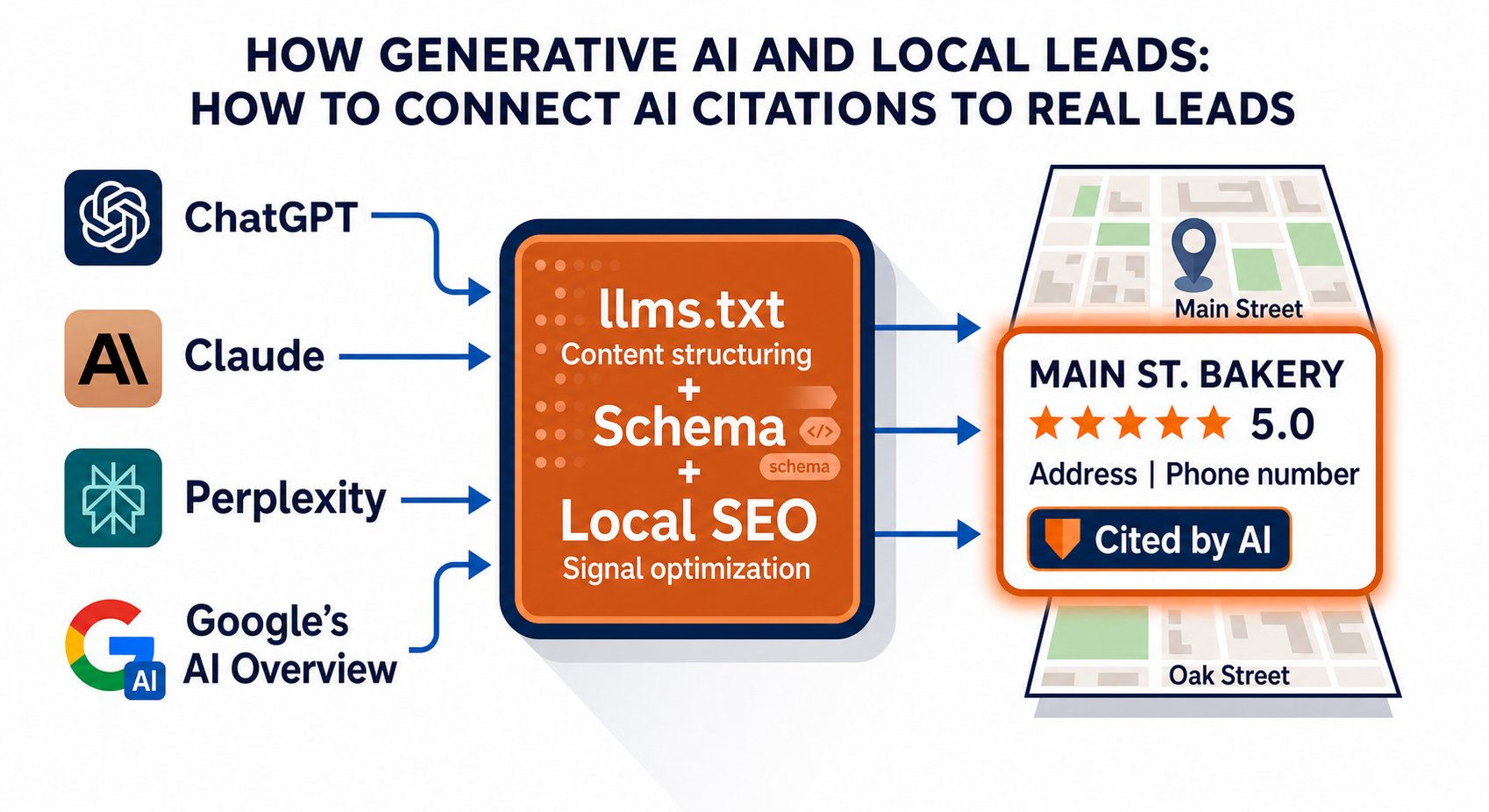
Chaz Edward’s promotional text adds layers such as llms.txt, schema, and “AI readiness,” but that does not provide solid proof that these elements alone would be decisive for local recommendation by assistants. Caution is therefore required.
On a more classic point, however, Google’s documentation on content best practices for AI features in Search and on AI features in Google Search points toward foundational work: helpful content, understandable information, usable structure, consistent signals.
Why “position” in an assistant is not a stable metric
The other strong idea concerns what Steve Wiideman calls prompt drift. Search Engine Journal cites an analysis by Steady Demand according to which, for repeated local searches in Gemini, the cited sources overlap about 40% of the time, and the top recommended brand appears again only about 7% of the time, compared with stability of about 90% for Google’s local pack.
These figures are interesting, but they rely on a secondary source relayed by a media outlet, not on a detailed methodological study. The main takeaway should therefore be the general idea: assistant responses can vary greatly depending on wording, context, or session.
Practical consequence: tracking “the #1 position in ChatGPT” the way one tracked a traditional ranking makes little sense. It is better to observe trends:
- is your brand cited more often?
- is the information accurate?
- which pages or which sources support these responses?
- do the same facts reappear over time?
This is why several sources mention prompt libraries or sets of phrasings to monitor, rather than a single ranking.
Your customers’ words are often worth more than an SEO brainstorming session
On this point, the corpus is particularly useful because it reconnects with a simple practice. Search Engine Journal emphasizes the value of call transcripts and chat logs for understanding how customers actually phrase their needs.
The idea is not spectacular, but it is solid: assistants respond to conversational phrasing, not just short, rigid keywords. If your site speaks in very polished marketing language but is far from the questions your prospects ask on the phone, there may be a gap.
You can therefore audit:
1. the words used to describe a problem;
2. the questions asked before purchase;
3. recurring concerns about price, timing, or coverage area;
4. the expressions your customers use that your site never uses.
This is a useful path, provided confidentiality, data access, and the rules applicable to the recording or analysis of conversations are respected.
Reviews are not disappearing from the landscape; they are changing in scope
Everyone agrees on the importance of multi-platform reviews, not just those from Google Business Profile. Search Engine Journal reports that Steve Wiideman specifically mentions Yelp, recalling its connections with Bing, Apple Maps, and its partnership with ChatGPT.
He also mentions a target range of about 4.5 to 4.7 for the average rating. Here again, the trap of the magic number should be avoided. It is not an official universal threshold; it is a benchmark cited in a professional exchange.
What can be retained more confidently:
- recent and credible reviews remain trust-building signals;
- presence on several platforms can matter if assistants aggregate diverse sources;
- an absent or inconsistent local reputation can weaken trust.
In other words, if your review strategy is limited to a single platform, that is not necessarily wrong, but it may be too limited for an environment where multiple datasets intersect.
A reasonable method to get started, without turning a weak signal into certainty
If you manage a local business or a network of locations, here is a more cautious method than chasing an “AI hack”:
1. Identify the exact level of the symptom
First ask yourself:
- are we lacking visible citations in assistants?
- are we receiving branded searches without understanding where they come from?
- are we seeing missed calls outside business hours?
- does the problem concern inconsistent local data?
- or conversion after the visit?
Without this sorting, you risk applying a technical response to a business problem, or the other way around.
2. Create minimal but clean tracking
Start with:
- an analytics segment for identifiable AI referrals;
- a “How did you hear about us?” question in forms or call scripts;
- simple call qualification: new lead, existing customer, out of target, missed call;
- a record of branded searches and actions on local listings.
It is not perfect, but it is already more useful than a binary verdict such as “AI is useless” or “everything comes from AI.”
3. Check what your pages actually say to a machine
Check at minimum:
- the main number displayed in the HTML;
- NAP consistency across site, profiles, and directories;
- hours, areas served, and services by location;
- the existence of truly useful local pages, not thin duplicates;
- the presence of clear answers to real customer questions.
4. Test reversible actions first
A few examples of reversible actions:
- improve a priority local page;
- clarify a call number and hours;
- better capture after-hours demand;
- enrich answers to recurring questions;
- launch a review audit across several platforms.
On the other hand, anything involving content variations by agent, complex phone attribution, or files and signals presented as miracles deserves a limited, documented, and reviewed test.
What multi-site networks need to watch even more closely
The corpus rightly insists on governance for multi-site brands. The more locations you have, the more you expose:
- unauthorized numbers;
- divergent hours;
- contradictory local descriptions;
- duplicate listings;
- very uneven review responses.
Search Engine Journal reports that Steve Wiideman even places this governance above certain classic ranking signals at scale. The phrasing is strong, but the idea is credible: when assistants aggregate multiple sources, local disorder becomes more costly.
For a network, the priority is therefore not only to “appear in AI.” It is to prevent AI from reconstructing an inconsistent image of the brand from scattered data.
The right starting decision depends on the real symptom, not the buzzword
If you should retain only one thing, it is this: visibility in AI assistants may already contribute to local leads, but direct evidence remains partial, low in volume, and highly context-dependent.
The right question is not “how do we optimize for AI?”. The right question is rather:
- which cache level is involved? Here, by operational analogy, which level of the journey keeps the trace: visible referral, branded search, call, local listing, or nothing at all?
- which symptom is being observed? Low referral traffic, after-hours calls, data inconsistencies, lack of citations, poor conversion?
- which facts have been verified? Internal figures, logs, qualified calls, cited sources, technical tests?
- which action is reversible? Adjust a page, improve attribution collection, correct local data, test an after-hours setup.
It is less spectacular than a promise of “AI visibility.” But it is much more solid for making a useful decision.
For some businesses, it may already be a lost cause if they let AI influence the decision without even measuring its real impact over time. And since everything is moving very fast, the most profitable move is often still to limit missed opportunities : inconsistent local data, missed calls, weak local pages, and no attribution question on the team side.
In the same topic
- JetGEO, Crocoblock’s new WordPress release: AI crawler control or just a marketing layer?
Shared topics : Digital · SEO · AI
- November 2021 Spam Update: Google Releases a New Anti-Spam Update to its Algorithms
Shared topics : Analytics · Digital · SEO
- Google Search Profiles: what changes for American media and creators in September 2026
Shared topics : Digital · SEO
- WordPress Black Friday – Cyber Monday Deals 2025
Shared topics : Digital

Revolut case: How an Institutional Address Was Able to Be Used for a Data Leak
An Italian PEC was reportedly used to obtain the data of hundreds of Revolut customers. The known facts, the KYC issue, and the privacy…
Read the article
The Best WordPress Plugins Halloween Deals 2025
⚡ Find the latest Deals of Halloween 2025 Discount Coupon code 🎃 Latest Promo Codes ⏩ WordPress Plugins & Themes. Don't miss out!
Read the article
Facebook Has Added New Features to Your Business Suite Application
Facebook added story planning, and “Business Discovery” options to it's Business Suite platform.
Read the article